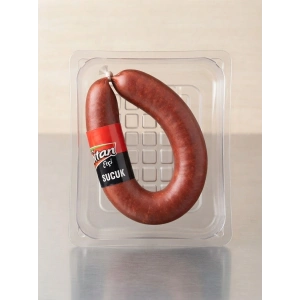
What Does Heat-Treated Sucuk Mean?
Date: 08.03.2022 17:05

Sucuk is a food product that can be produced in two different forms: heat-treated sucuk and fermented sucuk. Naturally, the fact that sucuk has undergone heat treatment or fermentation causes differences in its flavor. Just as suitable conditions are required for the fermentation process, certain conditions are also necessary for the production of heat-treated sucuk.
In this article, we will discuss what heat-treated sucuk is, what should be taken into consideration during the production of heat-treated sucuk, and what the differences are between fermented and heat-treated sucuk, and we will try to provide you with information.
How Is Heat-Treated Sucuk Made?
Ensuring that each nutrient is consumed in sufficient and balanced amounts is of great importance for a healthy, productive, and long life. Therefore, foods are expected to be prepared without losing their nutritional value. For this reason, it is in your best interest to choose producers whose quality you trust.
According to the Turkish Food Codex Communiqué on Meat and Meat Products, the pH value is important for heat-treated sucuk. In order for it to undergo this process, its pH value must not exceed 5.6.
According to the Turkish Food Codex Union on Meat and Meat Products, the total meat protein content must be at least 14%, while the collagen content must not exceed 25% of the mass of the total meat proteins. In addition, the communiqué sets the maximum moisture content at 50%. According to this communiqué, the ratio of moisture content to total meat protein must be below 3.6. It is also stated that, for heat-treated sucuk, the ratio of fat content to total meat protein must be below 2.5, and production should be carried out when these conditions are met.The production of heat-treated sucuk also offers advantages to producers. According to producers, the greatest advantage in this regard is that the production process is very short. In other words, while traditional sucuk production requires a production period of 10–12 days, heat-treated sucuk can be produced within a few days in small businesses. The process of producing heat-treated sucuk and placing it on the market is considerably shorter.
Large-scale producers, on the other hand, apply a few days of drying after a 2–3-day fermentation period followed by heat treatment, and then offer the sucuk for sale on the market.
Another reason—and the most important reason—why producers have incorporated heat treatment into the production process is that poultry meat has also begun to be used in the production of sucuk. Due to hygiene requirements, sucuk made from poultry meat must undergo heat treatment. Heat-treatment practices provide products with microbiological stability and prevent potential hazards.
Heat-treated sucuk is produced by carrying out all stages of sucuk production in the usual manner. In other words, fatty meat is minced and mixed with special spices, then filled into special casings and left to dry. In fermented sucuk, bacteria or spices are relied upon during this stage. Bacteria and spices help the sucuk mature and cook. In the case of heat-treated sucuk, however, there is no need to wait for this process. Heat—in other words, temperature—is applied to the product. This process prevents the sucuk from fermenting. The product matures with the help of heat. Before consumption, it only needs to be heated.
So, what is the heat treatment applied by producers? What are the rules of heat treatment?
What Is Heat Treatment in Food?
With the development of technology and increased awareness today, the food industry has turned toward producing products that are nutritionally rich, safe, and have a long shelf life, in parallel with the growing demand for ready-to-eat foods. Products with a long shelf life are preferred and consumed more widely by consumers.
In response to the demand for long-shelf-life products, packaging has become an important production stage for increasing the storage stability of ready-to-eat sliced meat products. In general, foods are packaged to protect them from factors that cause spoilage, facilitate transportation, communicate with consumers as a marketing tool, and provide consumers with products that are easy to use and prepare through product information. Another important issue before packaging is determining which processes the products will undergo.
There are two types of sucuk: fermented and heat-treated sucuk. The heat treatment applied both extends the product’s shelf life and ensures hygienic consumption.
Heat treatment is preferred to extend the shelf life of meat products compared with processes such as nonthermal irradiation and high-pressure application. In heat-treated meats, it is possible to inhibit pathogenic microorganisms, reduce production costs, and shorten production time. Therefore, it is a method frequently preferred by producers. Both small- and large-scale companies commonly use this method.
This process, which became necessary after poultry meat began to be used in sucuk production, has certain procedures. For example, according to the Turkish Food Codex Communiqué on Meat and Meat Products, if red meat is used in the production of heat-treated sucuk, the core temperature must reach at least 68°C; if poultry meat is used, it must reach at least 72°C.
Differences Between Heat-Treated Sucuk and Fermented Sucuk
The basic principle is that sucuk mixtures prepared using separate recipes are matured in different ways. Therefore, there are natural differences between heat-treated sucuk and fermented sucuk.
- Heat treatment is never applied to fermented sucuk; it is left to mature naturally. Heat-treated sucuk, on the other hand, is cooked.
- Fermented sucuk contains somewhat more spices quantitatively. This is because the spices cook the meat. Heat-treated sucuk contains fewer spices.
- Fermented sucuk takes much longer to produce, whereas heat-treated sucuk is produced in a shorter time. The cooking process is brief.
- Fermented sucuk relies on bacteria and microorganisms, while heat-treated sucuk relies on heat.
- Fermented sucuk is more expensive. Heat-treated sucuk is much more economical.
- Producing fermented sucuk requires more equipment, and separate areas must be allocated for the designated stages to take place. Heat-treated sucuk can also be produced by smaller businesses.
- Fermented sucuk has a stronger flavor, whereas heat-treated sucuk has a milder flavor.
- Fermented sucuk is cooked more carefully, while heat-treated sucuk is merely reheated.
Fermented or Heat-Treated Sucuk? Which Sucuk Should We Choose?
There is no difference between fermented sucuk and heat-treated sucuk until the stage at which they are filled into casings. Fermented sucuk is simply more heavily spiced.
Although there is no difference between them in terms of taste, flavor, or aroma, there is a significant economic difference. Heat-treated sucuk is preferred more frequently because it is more economical. However, some people find fermented sucuk more delicious. This is because sucuk has traditionally been a food that is left to mature naturally. The fermentation method is the most classic method of sucuk production. If you prefer sucuk made from poultry meat, you should definitely choose heat-treated sucuk; if you prefer traditional Turkish sucuk and want an intense flavor, you should choose fermented sucuk.
Related Products