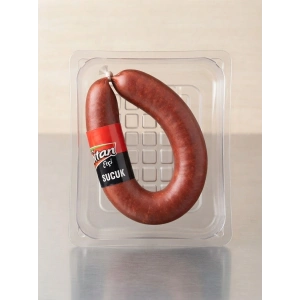
Sucuk is a food product obtained by filling fermented minced meat blended with special spices into inflated and dried intestines. Frequently consumed mainly in Armenia, Bulgaria, and Turkey, sucuk is thought to have come to our tables from Central Asia and is a type of food loved by everyone. It must be produced meticulously by manufacturers in factories.
As defined in the TS 1070 Turkish Standard, traditional Turkish sucuk is produced by mincing meat and fat in a meat grinder or cutter, blending them with various spices, subsequently adding salt and additives, and filling the resulting mixture into natural or artificial casings. The mixture filled into these casings is matured under suitable conditions and in an appropriate environment, at a specified temperature and relative humidity. These processes produce sucuk. Sucuk can be made both in factories and at home.
Have you ever wondered how sucuk, deliciously produced by manufacturers, is made? In this article, we will focus on how sucuk is made in factories. We will provide you with information about its journey until it reaches your table and share all the details about factory-produced sucuk.
Sucuk, which can be described as one of the oldest fermented food products, has varieties such as Kangal, Baton, Parmak, and Varyanta, and is also named differently according to its intended use. Manufacturers follow different methods at every stage, from preparing the sucuk mixture to producing the various types of sucuk.
Sucuk can be divided into two categories: fermented and heat-treated. Let us see how it is produced in factories.
Sucuk Production in a Factory
Certain stages and suitable conditions must be established for the production of sucuk in a factory. Although these stages may vary from one manufacturer to another, they are generally similar. First, suitable facilities are required for good sucuk production. After facilities with the appropriate and necessary equipment have been established, slaughtering must be carried out under the supervision of a veterinarian. This is a necessity both ethically and hygienically.
In suitable facilities, meat from cattle, buffalo, sheep, goats, or poultry slaughtered with the approval and supervision of a veterinarian is required. Alternatively, mixtures of these meats prepared in specific proportions may be used. The following stages are then carried out, and the sucuk is made ready for sale.
- The first stage in making sucuk in a factory is maturing the meat to be used. The meat selected by the manufacturer must be matured and its acidity must be reduced. The slaughtered meat should be rested for a period so that its acidity falls to a pH of 5.4–5.8. Veterinary support should be obtained at this stage, and quality standards must always be observed.
- Once maturation is complete, the meat is separated from the bones and passed through a large-plate meat grinder for factory sucuk production. It is important that the grinder used here has a large plate and that its blades are sharp and high-quality. This ensures proper mincing and uniform preparation of the sucuk.
- Adding salt, sodium nitrite, ascorbic acid, and sugar to the meat passed through the grinder is necessary for factory sucuk production. These substances assist with curing.
- Factory-produced sucuk has a mosaic structure. Fat must be added to create this structure and aid drying. The added fat also plays an active role in giving the sucuk a soft texture. The type of fat may vary according to the manufacturer’s preference.
- There is a special spice blend that varies from one manufacturer to another. Therefore, factory sucuk production differs for each manufacturer. The mixture containing this special spice blend is transferred to a mixing machine, where it is mixed without exposure to air.
- The mixture, blended in special factory mixers without exposure to air, is filled into natural or artificial casings.
- After the prepared sucuk mixture is filled into the casings, it is shaped and tied according to its type. The structure of the casing used is particularly important. For example, if an artificial casing is used, it must be capable of allowing oxygen and water vapor to pass through and must be shrinkable. All these stages are completed without manual contact.
- Sucuk produced by the manufacturer in the factory is filled into casings, tied, and hung. The sucuk pieces are hung on racks without touching one another and left to rest for a period.
- During the resting stage, the water in the casings drains away, and the mixture fills the casing thoroughly. To complete this process, the sucuk must rest for approximately 6–12 hours at 10–15 degrees. Experts monitor the process continuously.
- After the factory-produced sucuk has been rested under the required environmental conditions and temperature, it is transferred to maturation rooms. In these resting rooms at the production facilities, drying takes place alongside fermentation.
- The fermentation process may vary according to the manufacturer. Fermentation may occur naturally or by adding pure cultures to the sucuk mixture. This decision belongs to the manufacturer.
- During this fermentation stage, the meat is continuously monitored by experts. The process continues until the moisture content of the final product falls to approximately forty percent.
- The final stage of making sucuk in a factory is storage and packaging. Products stored in cold rooms below ten degrees, with 65–75% relative humidity and an air flow of 0.05 m/s, are packaged once their moisture content has fallen to forty percent, their color development has been completed, they have become suitable for slicing, and their taste and aroma have settled.
- The next stage for sucuk whose packaging has been completed by the manufacturer is marketing. Factory sucuk production is completed, and the sucuk is offered for sale.
Stages Considered Important by Sucuk Manufacturers
Each sucuk manufacturer may have a different method. However, these processes must comply with certain rules required by quality standards. The points that must be considered to produce good-quality sucuk apply to every company. Therefore, the points taken into account in factory sucuk production are listed below.
Sucuk can be produced using two different methods: fermentation and heat treatment. There are two different types: fermented sucuk and heat-treated sucuk. These varieties are produced through different processes in factories.
Because sucuk is made from meat and consumed with pleasure by everyone, particular points require extra attention. The issues that must be considered when making sucuk in a factory are listed below.
- Using high-quality meat,
- Ensuring that the meat has been rested properly after slaughter,
- Carefully monitoring the pH balance,
- Removing bones, coarse fat, tendons, ligaments, lymph nodes, large blood vessels, nerves, and fascia from the meat to be used in sucuk production,
- Using fat, tail fat, or subcutaneous fat in production,
- Properly balancing the proportions of meat and fat when preparing the mixture,
- Not using DFD or PSE meat (DFD = Dry, Firm, Dark; PSE = Pale, Soft, Exudative),
- Preferring the use of nitrite and monosaccharides,
- Ensuring that the additives used in production are pure and of high microbiological quality,
- Hanging the sucuk in the maturation room without allowing the pieces to touch one another,
- Correctly adjusting humidity levels, air flow, and temperature.
A suitable environment must be created in the factory for fermentation. Initially, the relative humidity in the environment should be 95%, and this level should be reduced to 75–80% toward the end of the maturation period. At the beginning, the air flow in the environment should be 1 m/s, and it should be gradually reduced throughout maturation. The ambient temperature is very important during fermentation. It should be between 18 and 22 degrees. After all these stages, factory sucuk production is complete.